
Legacy app modernization updates aging applications so they run securely, scale under load, and support AI and analytics workloads, while aiming to reduce the operating cost of keeping old systems alive. The right posture is never a single big rewrite. You inventory the application portfolio, score each system on business value and technical health, then deliver changes in prioritized waves using whichever of the 6/7 Rs fits each app.
TL;DR:
- Most modernization efforts start with a clear inventory and dependency mapping, focusing on systems with high business value and poor technical health.
- Using the 6/7 Rs framework, applications are treated individually, with strategies like rehost, refactor, or retire based on dependency complexity and business impact.
- Prioritizing low-risk, high-value pilots creates early wins, enabling scalable wave-based migration that minimizes downtime and manages complex dependencies.
- Data migration is the riskiest part, requiring detailed testing, small batch processing, and careful tracking to avoid hidden dependencies and preserve business logic.
- External expertise is advisable when dependencies are unclear, time is limited, or migration impacts revenue-critical systems, while in-house teams suffice for well-understood, low-risk applications.
Table of Contents
- What Legacy App Modernization Means for IT Leaders
- What Results Should You Expect From Modernization?
- Which Modernization Strategy Should You Use: The 6/7 Rs
- How Do You Prioritize and Sequence a Legacy Modernization Portfolio?
- How Do You Implement Modernization Waves in Practice?
- Why Is Data Migration the Riskiest Part of Modernization?
- What Are the Biggest Risks in Legacy Modernization, and How Do You Mitigate Them?
- How Qoode Scopes and Delivers Modernization Engagements
- When Should You Modernize In-House vs. Hire a Specialist?
- Ready to Scope Your Modernization Roadmap?
- Sources
- FAQ
What Legacy App Modernization Means for IT Leaders
Legacy app modernization covers three layers, not one. It includes the application code itself, the data and databases that code depends on, and the infrastructure that hosts it. A project that only re-skins the user interface while leaving a 15-year-old monolith and its brittle batch jobs untouched is not modernization. It is a facelift, and it will not solve the problems that pushed the initiative onto your roadmap in the first place.
What actually falls inside scope: application architecture, data models and storage, integration points (including tax and compliance systems such as electronic invoicing platforms), authentication and access control, and the deployment pipeline. What typically stays out of scope in a well-run first wave: unrelated systems that don't share dependencies with your priority applications, and organizational restructuring that isn't strictly required to support the new architecture.
The business case usually writes itself once you look at the numbers your team already tracks. Time-to-market suffers when every new feature requires touching a monolith that takes engineers months to understand. Compliance risk climbs when a vendor stops patching a platform your finance team relies on. And AI readiness is close to impossible on systems that can't expose clean APIs or structured data.
Common triggers worth flagging to your leadership team:
- A vendor announces end-of-life or end-of-support for a platform you depend on.
- Your best engineers spend more time working around the system than building on it.
- Customer-facing release cycles have stalled at quarterly or slower.
- Security audits keep flagging the same unpatched dependencies.
- Cloud infrastructure costs for the legacy stack keep rising with no corresponding growth in usage.
Any one of these is a reasonable starting point for a modernization business case. Two or three together usually mean the conversation with your board is overdue.
What Results Should You Expect From Modernization?
Modernization done well shows up in both engineering metrics and business numbers, and you should track both from day one. On the engineering side, look at deployment frequency, lead time for changes, change failure rate, and mean time to recovery, the same category of measures that DevOps Research and Assessment (DORA) research popularized for judging software delivery performance. A team stuck deploying monthly with a high failure rate has very different modernization needs than one already deploying weekly but wrestling with database performance.
On the business side, track:
- Cost per transaction or per user session, before and after each wave.
- Time-to-market for new features tied to the modernized system.
- Incident volume and severity for the application in question.
- Developer onboarding time (how long until a new hire ships their first change).
- Infrastructure spend relative to usage growth.
Statistic Callout: Industry reporting on well-executed modernization programs points to release cycles running 30 to 50 percent faster alongside meaningful cost reductions, though the exact gain depends heavily on your starting architecture and how disciplined your wave sequencing is.
Set success criteria before the first pilot wave starts, not after. A pilot that "felt smoother" isn't a result. A pilot that cut deployment lead time from three weeks to three days, with zero regression defects in the first 30 days of production, is a result you can take to the next wave's funding conversation. Structured modernization programs that pair governance with automation, an approach enterprise vendors like IBM have built entire practices around, tend to hold that discipline better than ad hoc efforts.
Which Modernization Strategy Should You Use: The 6/7 Rs
The 6 Rs, sometimes extended to seven, are the standard vocabulary for describing how to treat each application in your portfolio, a framework Microsoft's application modernization guidance lays out clearly for exactly this purpose. Very few real portfolios use just one R. Most use a blend, matched to what each system actually needs.
- Retain. Leave the application as is, at least for now. Right for low-risk systems nearing natural retirement, or ones where the cost of change outweighs any benefit.
- Rehost. Move the application to new infrastructure, typically the cloud, with minimal code changes ("lift and shift"). Fast and low-risk, but it carries forward the same architecture and technical debt.
- Replatform. Make targeted changes, like swapping a database engine or container runtime, without a full rewrite. A middle path when you need some cloud-native benefits fast without a multi-year rebuild.
- Refactor. Restructure the existing code to improve maintainability and performance without changing external behavior. Higher effort than rehosting, but it pays off when the app's logic is sound but its structure is not.
- Rearchitect or rebuild. Redesign the application, often moving from a monolith to microservices or a modern web application development approach. Highest cost and risk, but it's the right call when the current architecture actively blocks your business goals.
- Repurchase or replace. Swap the custom system for a commercial off-the-shelf or SaaS product. Sensible when the function is not a competitive differentiator, think generic HR or expense tools.
- Retire. Decommission the application entirely. Often the most overlooked option, and frequently the one with the best return, since every retired app is one less thing to secure, patch, and pay for.
Decision signals matter more than the framework itself. High business value paired with poor technical health usually points toward refactor or rearchitect. Low business value with decent technical health often means retain or rehost, don't spend rearchitecting money on a system nobody depends on for growth. Low value and poor health is your retire or replace candidate, full stop.
Pro Tip: Don't force every application through the same R. A common, effective sequence is to rehost a system first to stabilize it on modern infrastructure, then refactor it in a later wave once the team understands its behavior in the new environment. Trying to refactor and relocate in one motion multiplies risk for no real benefit.
How Do You Prioritize and Sequence a Legacy Modernization Portfolio?
Start with an honest inventory. Pull data from your configuration management database if one exists, your cloud billing reports, application performance monitoring tools, and, critically, interviews with the engineers who actually maintain each system. Documentation is almost always out of date; the people running production incidents at 2 a.m. know things no wiki page captures. Quick wins at this stage: flag any application with a known end-of-life dependency, and flag anything nobody can confidently explain the purpose of.
Scoring works best as a two-axis model: business value against technical health. Business value factors include revenue contribution, user reach, and strategic importance. Technical health factors include code age, test coverage, dependency count, and known security gaps. Weight dependency count heavily, AWS's prescriptive guidance on wave-based refactoring treats dependency mapping as the dominant factor in safe wave grouping, because an app with dozens of hidden downstream dependents will blow up your timeline no matter how clean its own code looks.
Governance matters here too. Someone with real authority, not just an engineering lead, needs to sign off on the scoring so business stakeholders can't quietly reprioritize their pet project above a system that's actually failing.
Wave design follows a simple shape:
- Pilot wave: one or two low-risk, high-visibility applications. Entry criteria: clear ownership, manageable dependency count, willing business sponsor. Exit criteria: functional parity confirmed, KPIs met, lessons documented.
- Scale wave(s): the bulk of the portfolio, sequenced by dependency chains uncovered in the pilot. Entry criteria: pilot retrospective complete, tooling and patterns proven. Exit criteria: repeatable playbook, defect rates within target.
- Retire wave: systems identified for decommissioning throughout the process. Entry criteria: no active dependents remain. Exit criteria: clean shutdown, data archived per compliance requirements.
| Wave | Primary goal | Typical entry criteria |
|---|---|---|
| Pilot | Prove the approach | Low dependency count, engaged sponsor |
| Scale | Deliver bulk of value | Pilot playbook validated |
| Retire | Cut ongoing cost and risk | No remaining active dependents |
Programs that skip straight from inventory to a single massive rewrite, instead of sequencing in waves, are consistently where modernization efforts run into trouble, usually from underestimated dependencies rather than the wrong technology pick.
How Do You Implement Modernization Waves in Practice?
Wave-based delivery works because it forces early wins. Front-load a low-risk, high-value capability in your first wave so the team can point to a concrete result before asking for budget on wave two.
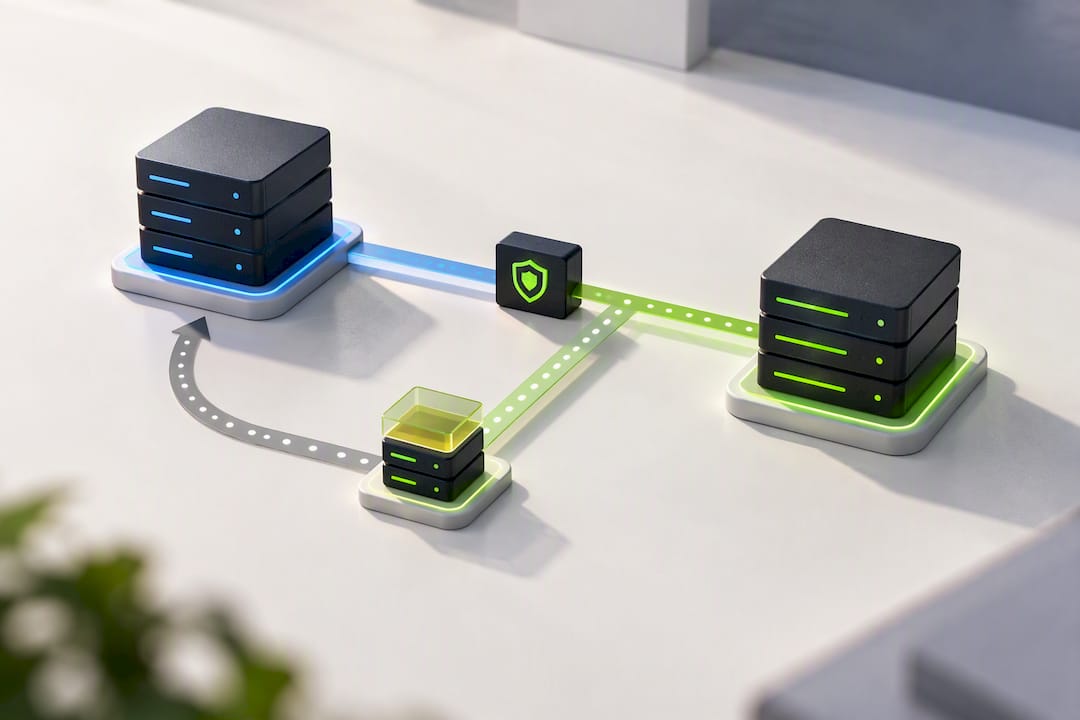
The strangler pattern is the workhorse technique for incremental cutover. You place a proxy or adapter layer in front of the legacy application, then route traffic for specific functions to new services one at a time, while the legacy system keeps handling everything not yet migrated. Over time, the legacy system's footprint shrinks until it strangles down to nothing and can be retired outright. This avoids the all-or-nothing risk of a hard cutover date.
Choosing among microservices, containers, and serverless depends on your workload shape, not fashion. Practical AWS wave implementations commonly map legacy capabilities onto managed services like Lambda, API Gateway, and managed databases for incremental replacement, reserving containers or a service mesh for waves with heavier, more tangled dependencies.
- Microservices fit when different parts of the application have genuinely different scaling and release needs, and you have the operational maturity to run distributed systems.
- Containers suit workloads that need portability and consistent environments without committing to full serverless constraints.
- Serverless works well for event-driven, bursty workloads where you don't want to manage servers at all, but it's a poor fit for long-running, stateful processes.
Operationally, moving from a monolith to any of these patterns means your team now manages more moving parts, which raises the bar on observability. Distributed tracing, centralized logging, and health checks per service stop being optional the moment you split a monolith into five services.
For rollout, blue/green deployment (running two identical production environments and switching traffic between them) and canary releases (rolling a change out to a small percentage of users first) both reduce the blast radius of a bad deployment. Neither replaces good testing, but both buy you a fast, controlled rollback path if something slips through. Security reviews should happen at each wave boundary, not just once at the end, since new integration points are exactly where new vulnerabilities tend to appear.
If your team lacks in-house experience running cloud-native architecture at this scale, this is often the point where it makes sense to bring in a cloud architect rather than let the first wave become an expensive learning exercise.
Why Is Data Migration the Riskiest Part of Modernization?
Data migration routinely turns out to be the highest-risk activity in a modernization program, and the reason is structural rather than accidental. Legacy systems frequently encode real business logic in places nobody expects, in the order records get processed, in the timing of batch jobs, and in database constraints that silently enforce rules the original developers never documented anywhere else, a pattern AWS's guidance on mainframe modernization calls out specifically as a reason data-level parity deserves as much scrutiny as functional parity.
A defensible testing approach has three layers:
- Differential checks that compare output between the old and new systems running the same inputs in parallel, catching discrepancies before they reach production.
- Automated regression suites that codify existing behavior as executable tests, so a passing suite becomes your evidence of functional parity rather than a developer's word for it.
- Golden-data comparisons against a known-correct reference dataset, run after each migration batch, not just once at the end.
Statistic Callout: Model-driven migration research shows that introducing an intermediate model to extract and abstract legacy artifacts can meaningfully cut manual migration effort, but bespoke, custom-built composites still require manual adaptation even in automated pipelines. Don't budget your migration timeline as if automation handles everything; budget it as automation handling the routine 80 percent while your engineers focus on the hard 20 percent.
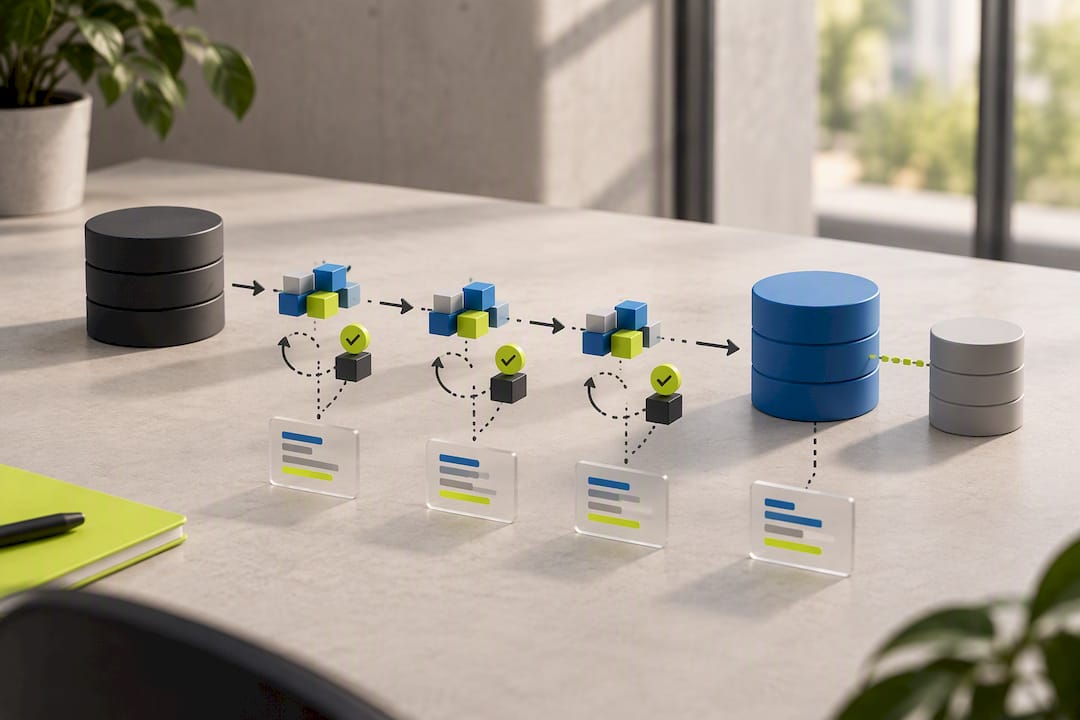
To limit downtime and keep an audit trail, run migrations in small batches with rollback points between each one, log every transformation for traceability, and keep the legacy system in read-only standby until the new system has proven stable in production for a defined burn-in period.
What Are the Biggest Risks in Legacy Modernization, and How Do You Mitigate Them?
Hidden dependencies are the single most common way modernization timelines blow up. An application that looks self-contained often has three other systems quietly reading from its database or calling an undocumented internal API. The first mitigation is always traceability: map every integration point before committing to a wave, not during it.
Other recurring risks and what actually addresses them:
- Scope creep: business stakeholders ask for new features mid-migration. Mitigation: a change-control process that requires new asks to go through the next wave's planning, not the current one.
- Security and compliance gaps: new integration points introduce new attack surface. Mitigation: a security review at every wave boundary, not just at project kickoff.
- Regulatory exposure: systems touching financial or tax data, such as fatturapa integration for Italian e-invoicing compliance, need explicit sign-off that the new system preserves every compliance requirement the old one met.
- No rollback plan: teams assume the migration will work and skip planning for when it doesn't. Mitigation: a tested rollback procedure that's rehearsed, not just documented, before the go-live date.
Pro Tip: Require your team, or your vendor, to produce a dependency map before any wave gets funded. It costs a few days upfront and routinely saves months of rework once someone realizes a "standalone" app was feeding three downstream reports nobody flagged.
How Qoode Scopes and Delivers Modernization Engagements
Qoode approaches legacy modernization as a staged engagement, not a single monolithic project handed over at the end. A typical arc runs through inventory and dependency mapping, a prioritized roadmap with wave sequencing, a pilot build, staged migration with parallel testing, and a formal handover.
What that looks like in practice:
- Inventory and roadmap: documenting current-state architecture, dependencies, and technical health before committing to a strategy per application.
- Pilot delivery: building the highest-value, lowest-risk wave first, so you see working software and real metrics before scaling the approach.
- Migration and testing: running differential and regression tests to confirm functional and data parity before any cutover.
- Handover: delivering full source code, infrastructure configuration, and documentation, so the client owns everything shipped.
Code and infrastructure ownership sits at the center of how Qoode structures every contract. Clients see working deliverables throughout the build rather than waiting for a single reveal at the end, and every engagement starts with a clear scope, timeline, and cost before work begins. For work spanning custom back-office systems, that same model applies to ERP development projects that need to modernize core operational software without losing the business logic that keeps daily operations running.
When Should You Modernize In-House vs. Hire a Specialist?
Internal teams should lead when the system is well understood, the team has bandwidth beyond firefighting, and the risk profile is low, think retain or rehost decisions. Bring in a specialist when dependencies are murky, the timeline is tight, or the rearchitecture touches revenue-critical systems your team can't afford to learn on. Gate every pilot with clear exit metrics before scaling, and negotiate code ownership and measurable outcomes into the contract from day one, not as an afterthought once the invoices start arriving.
Ready to Scope Your Modernization Roadmap?
Qoode is the practical alternative to a slow internal rebuild or a black-box outsourcing contract for legacy app modernization: you get a scoped inventory, a wave-sequenced roadmap, and full ownership of the code and infrastructure once it's delivered, with no lock-in to a proprietary platform or an agency that keeps the keys.
Whether your priority is custom software development for a core system due for a rearchitect, or web application development to replace a legacy ASP.NET monolith, the engagement starts the same way: a scoped assessment of your portfolio, with transparent cost and timeline before any commitment. If AI readiness is part of your roadmap, that assessment can also flag where AI and automation work fits into later waves. Reach out through Qoode's solutions page to request a scoped assessment of your legacy portfolio and get a wave plan built around your actual dependencies, not a generic template.
Sources
- Mainframe modernization with agentic AI – AWS Transform for mainframe
- The 6 Rs of application modernization - App Modernization Guidance | Microsoft Learn
- Model-driven approach to legacy system modernization (arXiv)
- Application Modernization Services | IBM
FAQ
What Is the Difference Between Legacy Modernization and a Full Rewrite?
Modernization is a portfolio decision that can include rewriting some applications, but it also covers rehosting, replatforming, or even retiring others based on their business value and technical health. A full rewrite is one possible strategy within the 6/7 Rs framework, reserved for systems where the current architecture actively blocks business goals.
How Long Does Legacy App Modernization Typically Take?
Timelines depend entirely on portfolio size and complexity, a single application rehost can take weeks, while a multi-year enterprise program with dozens of interdependent systems can run several years across multiple waves. Sequencing in prioritized waves, rather than one large project, is what keeps a long program manageable and lets you show results early.
How Much Does Legacy App Modernization Cost?
Cost varies widely based on scope, strategy, and how many applications are involved, so there's no universal figure to quote. Qoode's custom software and modernization projects are scoped individually with transparent pricing provided upfront; current details are available on Qoode's solutions page.
Can You Modernize an App Without Downtime?
Techniques like the strangler pattern, blue/green deployment, and canary releases are specifically designed to minimize or eliminate downtime during cutover. Running the legacy and new systems in parallel with differential testing lets you validate the new system before fully retiring the old one, cutting the risk of a hard, disruptive switchover.
Do I Need to Migrate All My Data at Once?
No, and batch migration is generally safer than a single big-bang cutover. Migrating in small batches with rollback points between each one, combined with golden-data comparisons, reduces the risk tied to the business logic often hidden in legacy data ordering and constraints.