
Reducing technical debt starts with making it visible: build an inventory, quantify each item's carrying cost, rank by interest rate, and reserve standing capacity to pay it down every sprint. Start this week by logging your worst offenders, attaching a repayment plan to each, and reserving a portion of next sprint's capacity for paydown. Do this consistently and you will see faster lead times and fewer production incidents within one or two quarters.
TL;DR:
- Logging and prioritizing high-interest, low-cost debt items enables rapid progress while avoiding large, expensive fixes that require leadership approval.
- Using a live, code-linked inventory and scoring debt by interest and paydown cost ensures effective prioritization and alignment with business impact.
- Maintaining a standing budget of 10 to 30 percent of sprint capacity allows continuous debt paydown without competing with core delivery deadlines.
- Applying proven tactics like the strangler pattern, automated dependency fixes, and AI-generated tests reduces risk and accelerates legacy system improvements.
- Consistent measurement of lead time, failure rate, and operational signals within one to two quarters demonstrates tangible improvement from a structured debt reduction plan.
Table of Contents
- What Counts as Technical Debt You Need to Record?
- How Do You Measure Technical Debt?
- How Do You Build a Tech-Debt Registry?
- How Do You Decide What to Fix First?
- What Are the Best Paydown Tactics for Legacy Systems?
- Which Tools and AI Capabilities Actually Help?
- How Qoode Operationalizes Technical Debt Reduction
- Your 30/90/180 Day Plan
- How Qoode Can Help You Execute the Plan
- Sources
- FAQ
What Counts as Technical Debt You Need to Record?
Not every shortcut is technical debt, and treating them all the same way is why paydown programs stall. Technical debt is the future maintenance cost created by choosing an expedient solution over a durable one, similar to financial debt in that it accrues interest the longer it goes unaddressed. A rough edge with no owner and no plan is better labeled "tech-drag": a friction cost, not yet a tracked liability.
That distinction matters for how you prioritize. Tech-drag becomes tech-debt the moment someone assigns an owner, an estimate, and a due date. Until then, it just sits in the backlog collecting dust and slowing everyone down without a clear path to fixing it.
You will typically encounter debt in these forms:
- Code debt: duplicated logic, tangled conditionals, and functions that outgrew their original purpose.
- Architecture debt: monoliths that should be split, or services coupled so tightly that one deploy risks five others.
- Dependency debt: outdated libraries, frameworks nearing end of life, or unpatched packages with known vulnerabilities.
- Test debt: missing coverage on critical paths, flaky suites nobody trusts enough to gate a release on.
- Documentation debt: tribal knowledge that lives only in one engineer's head.
- Configuration debt: environment drift between staging and production that causes "works on my machine" bugs.
- AI and prompt debt: brittle prompts, unvalidated model outputs, or generated code merged without review.
Some of this debt is deliberate. A team ships a feature fast, knowing a shortcut exists, and plans to fix it later. Most of it is accidental: decisions that were correct at the time and became liabilities as the system grew. The implication for your repayment plan is different in each case. Deliberate debt usually has a known fix and a known cost. Accidental debt needs a diagnosis phase before you can even estimate the paydown.
How Do You Measure Technical Debt?
You cannot manage what you cannot measure, and technical debt is no exception. The strongest programs pair delivery metrics with code-level signals so a number on a dashboard maps to a dollar figure a finance lead can understand.
On the delivery side, track:
- Lead time for changes: how long it takes a commit to reach production.
- Change failure rate: the percentage of deployments that cause an incident or rollback.
- Deployment frequency: how often the team ships, which tends to drop as debt accumulates.
On the code side, watch cyclomatic complexity trends, duplication percentages, counts of deprecated API calls still in use, and test coverage on your highest traffic modules. Operationally, incident rates, bug backlog volume, and new-hire onboarding time all tend to move in the wrong direction as debt builds. A codebase that takes a new engineer six weeks to become productive in is telling you something concrete about its condition.
Pro Tip: Convert every metric into engineering days lost per sprint before you present it to leadership. "Complexity score of 42" means nothing to a CFO. "This module costs us roughly three engineer days a month in workaround fixes" gets budget approved.
The translation step is what makes debt paydown fundable. Quantifying debt in engineering days and business risk is what lets you defend a standing budget instead of relitigating it every planning cycle. Teams that skip this step tend to win one paydown sprint and then lose the argument for the next five.
How Do You Build a Tech-Debt Registry?
A spreadsheet dies within a quarter. Debt inventories that survive are the ones tied to living systems your team already touches: the issue tracker, code search, or a query against your own repositories. A live inventory driven from code replaces guesswork with a measurable trend line you can show in a quarterly review.
Here's a workable classification flow:
- Flag it as tech-drag first. Anyone who hits friction logs it, no ceremony required, just a ticket or a tagged comment in code.
- Route it through a weekly triage. An engineering lead reviews new drag items and decides whether they warrant analysis.
- Promote it to tech-debt only once a repayment plan exists. Practitioners recommend this exact gate because it stops the registry from filling up with vague complaints nobody intends to fix.
- Attach an owner, a size estimate, and a due date. Treat it the same way you would treat a customer-facing bug.
- Link it to the feature or incident that exposed it. This context is what makes prioritization conversations fast instead of political.
A repayment plan worth the name has four fields: who owns it, how many engineering days it costs, when it's due, and what "done" looks like. Skip the acceptance criteria and you'll get a refactor that technically closes the ticket while leaving the underlying risk untouched.
How Do You Decide What to Fix First?
Score every debt item on two axes: interest and paydown cost. Interest is the ongoing cost of leaving it alone. It shows up as slower delivery, higher incident rates, or engineer hours lost to workarounds. Paydown cost is what it takes to actually fix it, ideally expressed in engineering days.
Items with high interest and low paydown cost are your obvious first sprint. Items with low interest and high paydown cost can usually wait. The hard calls are high interest, high cost. Those need a leadership conversation, not a unilateral engineering decision, because they compete directly with roadmap commitments.
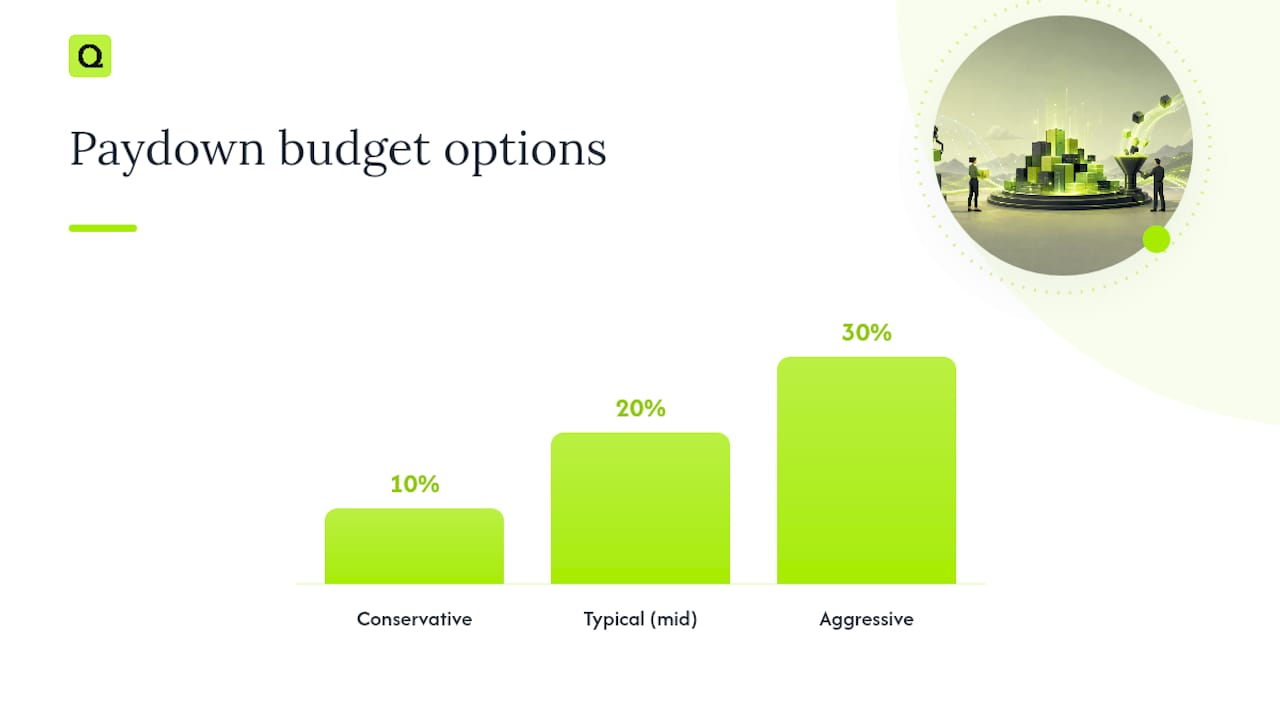
Fund the work with a standing allocation rather than a one-time initiative. Sourcegraph's guidance on a maintained registry paired with a standing paydown budget points to 10 to 30 percent of sprint capacity as a workable range for most teams, adjusted up when the codebase is older or the incident rate is climbing.
Protecting that budget takes discipline, since product pressure will try to claim it every sprint. A few mechanics that hold up in practice:
- Attach small refactors directly to feature tickets that already touch that code, so the fix rides along instead of competing for its own slot.
- Run a dedicated paydown sprint once a quarter for items too large to slip in incrementally.
- Apply the "leave it better than you found it" rule opportunistically. Any engineer touching a file cleans up one small thing while they're in there.
The goal isn't zero debt. It's a portfolio where the interest rate on what remains stays below what your delivery speed and incident budget can absorb.
What Are the Best Paydown Tactics for Legacy Systems?
Choosing the right tactic depends on how much risk the surrounding system can absorb, and getting this wrong is how "fix it properly" projects turn into eighteen month rewrites that never ship.
- Use the strangler pattern for anything customer-facing and load-bearing. Route traffic incrementally to a new implementation while the old one keeps running, rather than attempting a full rewrite. A big-bang rewrite makes sense only for small, low-traffic systems where the blast radius of a mistake is contained.
- Break large modules into smaller, independently testable units before you touch their logic. Modularization first, behavior changes second. Every refactor ticket needs written acceptance criteria, not just "clean up the auth module."
- Automate the mechanical fixes. Dependency version bumps and syntax-level codemods rarely need a human judgment call, so let tooling handle them in batches rather than one pull request per package.
- Generate a test baseline before you refactor anything without coverage. AI-assisted tools can infer legacy behavior and generate a baseline test suite, which gives engineers a safety net they didn't have to write by hand. This single step removes the biggest psychological blocker to touching old code: the fear of breaking something nobody understands anymore.
- Delete instead of fix when usage data says a feature is dead. The cheapest debt paydown is removing code nobody uses. Check analytics before you invest a sprint refactoring something that should be retired.
Which Tools and AI Capabilities Actually Help?
Static analyzers like SonarQube surface complexity and duplication trends automatically, which beats manual code review for spotting slow-moving rot. Dependency bots such as Dependabot or Renovate keep packages current without a human filing tickets, and integrating them into your CI pipeline prevents the kind of version drift that turns into a security incident. Code search platforms let you query your entire codebase for a pattern instead of relying on someone's memory of where the risky code lives.
AI adds real capability on top of that stack:
- Generating documentation for undocumented legacy modules, cutting onboarding time for new engineers.
- Synthesizing test suites for code that has never had coverage.
- Suggesting codemods for repetitive, low-risk mechanical changes across a large codebase.
- Recommending dependency upgrade paths, flagging which updates are safe versus breaking.
None of this replaces human review. AI-generated tests can encode a bug as if it were intended behavior, and a generated codemod applied blindly across hundreds of files can introduce debt faster than it removes it. Every AI-assisted change needs the same review gate a human-written pull request gets. A crawlability and tooling audit applied to your own automation pipeline is a useful habit for catching blind spots before they compound. Add CI checks that fail a build on new complexity spikes or coverage drops, and put a dashboard in front of engineering leadership so debt reintroduction gets caught the same sprint it happens, not two quarters later.
How Qoode Operationalizes Technical Debt Reduction
Qoode runs paydown work as a staged engagement rather than an open-ended cleanup project. It starts with a diagnostic that maps your codebase against the metrics above, moves into a prioritized roadmap scored by interest and cost, then proves the approach with a pilot paydown sprint before scaling to iterative delivery.
Engagements draw on technical leads to own the roadmap, engineers to execute refactors, DevOps specialists to harden CI gates, and AI-assisted workflows for documentation and test generation on legacy modules. Projects ship with a clear scope, fixed timeline, and cost transparency upfront. That last point matters more than it sounds: a paydown project that leaves you locked into someone else's tooling has just replaced one form of debt with another.
Your 30/90/180 Day Plan
Days 1 to 30: Build the registry, tag your top ten drag items, and get leadership sign off on the tech-drag to tech-debt workflow.
Days 31 to 90: Lock in a standing budget (start at 10 to 15 percent), run your first dedicated paydown sprint, and turn on dependency automation for mechanical fixes.
Days 91 to 180: Report lead time and change failure rate trends, adjust prioritization based on what actually moved the numbers, and make the repayment cadence a standing part of sprint planning, not a special initiative.
Loop in product, engineering, platform, and security stakeholders at each checkpoint. Debt that only engineering cares about gets deprioritized the first time a deadline gets tight.
— Qoode
How Qoode Can Help You Execute the Plan
Reading a framework and running it under deadline pressure are different problems, and most engineering teams already know exactly where their debt lives, they just lack the dedicated hours to fix it while also shipping the roadmap. Qoode works alongside your team on exactly that gap, through custom software development engagements built around a diagnostic, a prioritized roadmap, and a pilot sprint that proves the approach before you commit further budget.
That can mean a focused refactor of your highest interest modules, AI and automation development to generate test baselines and documentation for legacy systems, or bringing in a tech lead to run the paydown program day to day. Every engagement comes with an upfront scope, a fixed timeline, and full ownership of the resulting code, so you are not trading one dependency for another. If your registry already has a top five list and no bandwidth to attack it, start with a scoping conversation on the Qoode solutions page and get a concrete plan for what a pilot sprint would cost and deliver.
Sources
The SEI's technical debt recommendations cover organizational visibility and tooling in more depth. IBM's 2026 analysis links debt directly to AI initiative ROI. Sourcegraph's management guide details live inventory mechanics. Wikipedia's overview grounds the core concept.
- Reducing technical debt in 2026 | IBM
- Technical Debt Management: A Complete Guide for 2026 | Sourcegraph
- Technical debt — Wikipedia
FAQ
What Is Technical Debt Reduction?
Technical debt reduction is the ongoing practice of identifying, quantifying, and fixing the shortcuts and outdated code that slow down software delivery. It works best as a standing program with a dedicated budget rather than a one-time cleanup project, built around an inventory, prioritization by interest, and repeated paydown cycles.
What Is Technical Debt?
Technical debt is the future maintenance cost created by choosing an expedient development solution instead of a more durable one. It behaves like financial debt in that it accrues cost the longer it goes unaddressed, and it is often incurred without anyone deciding on it deliberately.
How Do You Remove Technical Debt?
You remove it by making it visible in a live registry, scoring each item by its interest rate against delivery speed and incidents, and funding a standing paydown budget of roughly 10 to 30 percent of sprint capacity. Pair that with tactics like the strangler pattern, automated dependency updates, and AI-generated test baselines to make the fixes safe to ship.
What Are the Four Types of Technical Debt?
Definitions vary across teams, but a common grouping covers code debt, architecture debt, dependency debt, and test debt, with documentation and configuration debt often tracked as additional categories. Most engineering organizations track more than four types in practice, since AI and prompt debt has become a growing fifth category as teams adopt generated code.
How Long Does It Take to See Results From a Paydown Program?
Teams that commit to a standing budget and consistent measurement typically see improvement in lead time and change failure rate within one to two quarters. The 30/90/180 day plan outlined above gives a realistic timeline: inventory and sign off in the first month, a working paydown sprint by month three, and measurable metric shifts by month six.